
How to watch the Perseids meteor shower
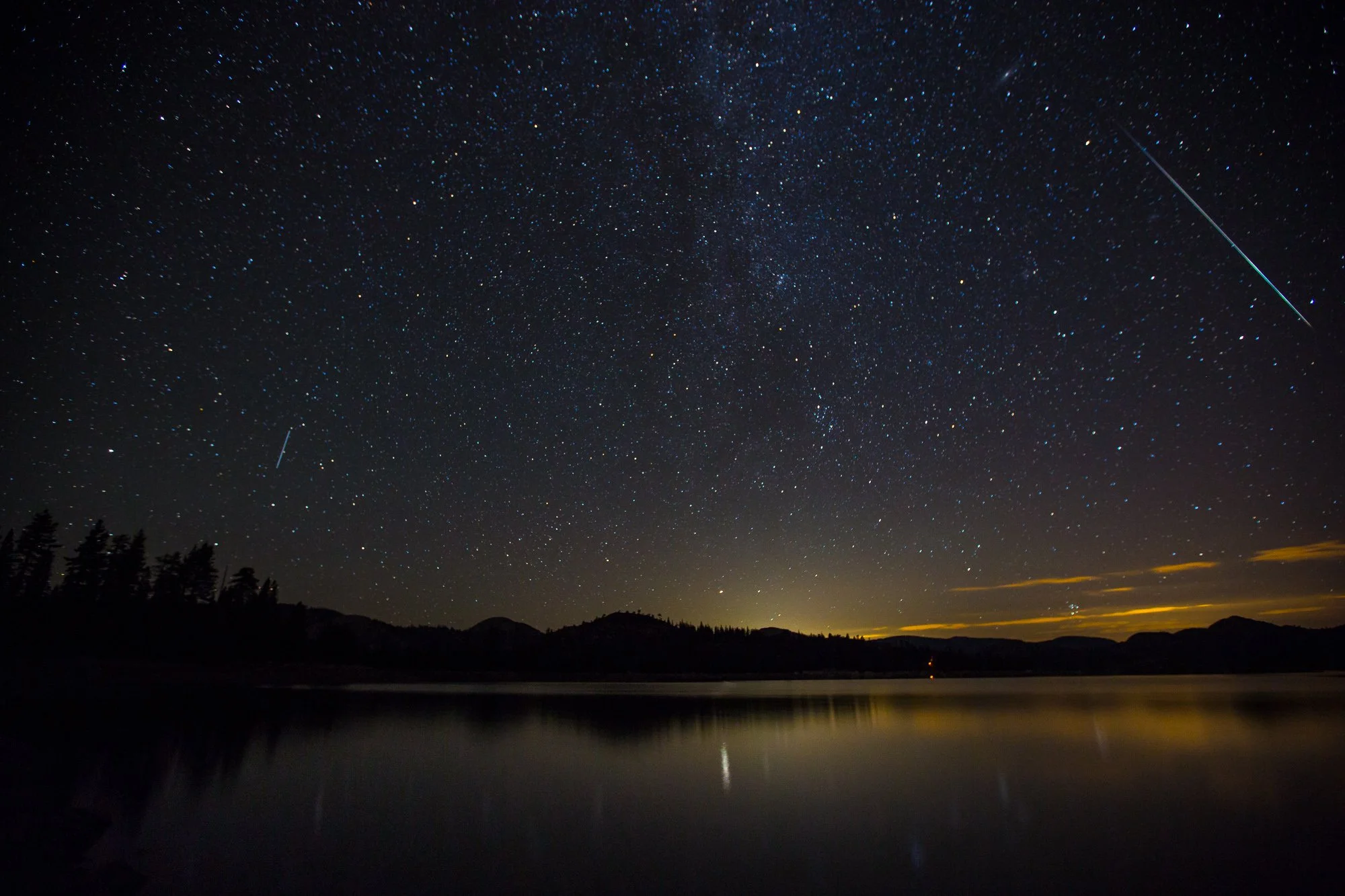
The Perseids, photographed by John Getchel
Q: What are the shooting stars we see on Georgian Bay every summer? When is the best time to watch them?
Answered by Cliff Harding, amateur astronomer (originally published in the 2019 Summer LandScript)
If you have been lucky enough to be outside under dark, clear skies around the 12th of August, you have likely seen one or more of the Perseid meteors or shooting stars.
The Perseid meteor shower comes around every year on August 12th or 13th, or I should say ‘we’ come around each August. The Perseid shower occurs as the earth passes through the orbit of the comet Swift-Tuttle. The comet last came by in 1992 and the next pass is in 2126.
The shower actually starts around July 23rd and goes until August 20th, but peak viewing is the 12th or 13th of August. Over thousands of years, the comet has left a trail of debris in its orbit that burns up in the earth’s atmosphere causing the meteors we see. Most of the meteoroids (meteoroids when in space, meteors when they burn up, and meteorites if they reach the ground) range in size from a grain of sand up to a small pebble, and are travelling at about 60 km/sec or 215,000 km/h. These shooters are fast! In general, meteors range in speed from 10 km/sec up to 72 km/sec, so these are at the speedy end of the scale. They typically burn up between 70 km and 100 km altitude and Perseids rarely reach the ground on Earth.
Meteor showers are named for the constellation in the part of the sky where they appear to radiate, in this case, the constellation Perseus. Perseus is about 30° above the horizon in the north-east at around mid-night. If you were to mark on a sky map the direction of all the meteors you see in an evening, they will all appear to radiate from a central point. This is caused by the direction of the earth’s orbit as we pass through the dust cloud. The visual effect is similar to driving in a snow storm at night. If you are watching the shower and see a meteor that crosses the usual paths, it is called a rogue meteor and is not part of the actual shower.
The nice thing about watching a meteor shower is that there is no equipment required, other than maybe a blanket and a lawn chair. Try to find a place where you can get a wide view of dark sky (on a dock, for example). If you can, it is best to look 30° to 40° away from the radiant. That way the meteors will cross your view and be easier to see. Just after sunset or pre-dawn are the best times for viewing, because the meteors are just grazing the atmosphere and will have longer tails. In ideal viewing conditions, you could see around 40 meteors per hour or more. Many of them can be very dim and will be very fast. It takes about 30 minutes for your eyes to become completely adjusted to the dark, so the more time you have the better. Remember though, it only takes a few seconds of white light to undo your 30 minutes of dark adjustment, so avoid flashlights if you can. On years when the moon is near full things will be washed out a bit, but you will still see the brighter meteors if you are patient and lucky. All of this obviously assumes a clear sky, of course.
Let’s hope for clear skies those nights, but if not, remember to keep watching for several days before and after August 12th. If you don’t see anything, remember that we’ll be back around in another year. Good luck and dark skies!