Official Bird Station Permit marks new milestone in species & land conservation
Some people say that supporting organizations like the Georgian Bay Land Trust is for the birds. You know what? They’d be right. Now more than ever.
If you spend time along Georgian Bay, you notice birds. They’re part of what makes the place feel wild and alive. The Bay sits within a critical migratory corridor and includes diverse habitats that support breeding, stopover, and overwintering birds. What you may not realize is that birds tell us a story about the health of the environment. The challenge? We can’t understand that story just by observing them. The announcement of a new, officially recognized bird Station Permit is a powerful step forward for the Georgian Bay Land Trust. It not only fuels our long-term research, but also allows us to pinpoint properties that need protection most, helping ensure every conservation effort counts.
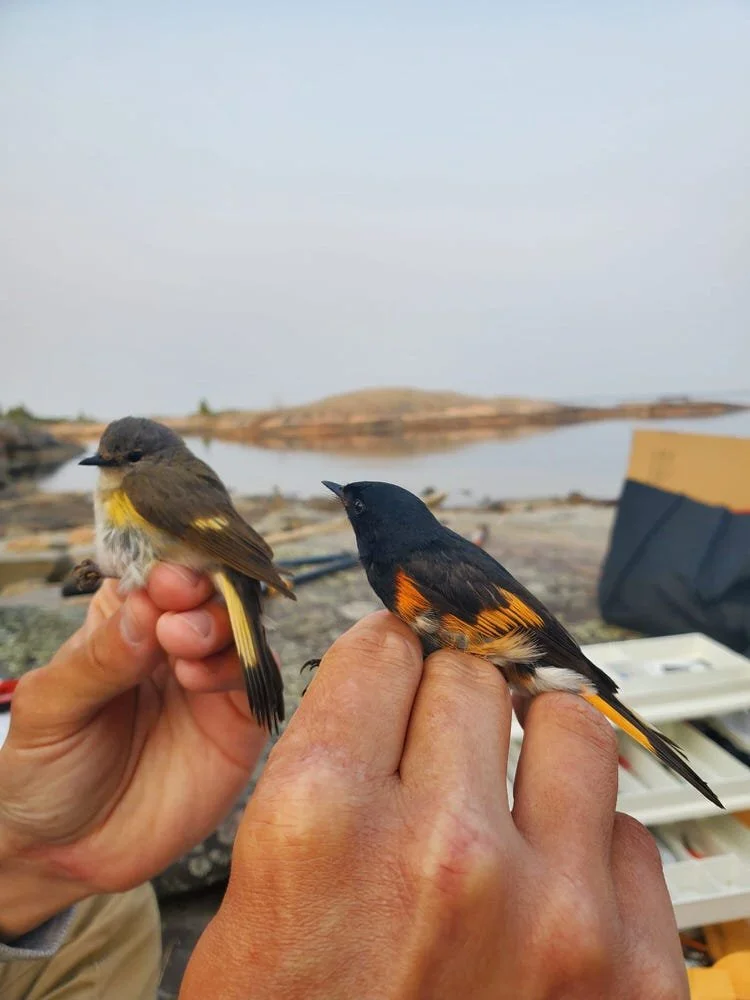
Two American Redstarts banded as part of the Land Trust’s MAPS (Monitoring Avian Productivity and Survivorship) research. Photo by Lauren Sideris.
In Ontario, a bird Station Permit is an official authorization that allows qualified researchers to capture, handle, band, and release wild birds for scientific study. It’s granted to locations where birds are safely caught using fine mist nets, then identified, measured, banded, and released.
It’s not something an individual or organization can get casually, says Aaron Rusak, Conservation Director at the Georgian Bay Land Trust. Demonstrated training, experience, and a clear research purpose is required. “I can't just apply for a permit just to catch birds. I need to have an actual project where catching birds is going to be valuable scientifically and the data that we're getting is going to be used.”
Aaron comes by his love for the Bay honestly. He moved to the Georgian Bay Land Trust about four years ago from the Muskoka Conservancy. His cottage in Go Home Bay has been in the family since the 1950’s. To obtain expert training and experience, Aaron spent time at Long Point Bird Observatory and the Hilliardton Marsh Research Centre, both banding stations. He earned a sub-permit over a two-year period before upgrading it to a Master's or a Station Permit. The advantage? A Station Permit is tied the Georgian Bay Land Trust as an organization, not just to Aaron as an individual. This ensures all data capture remains “in-house”, allowing for repeatable, season-after-season collection. It also signals that the research meets federal standards and follows approved protocols, building trust with regulators, partners, and you.
Rusak is quick to share something important that sets the Georgian Bay Land Trust's efforts apart from other land trusts and conservation organizations. “Data collected helps build mapping of critical habitat or stopover sites, which is mapped out to identify properties that should be protected. From there, we can do outreach to targeted landowners to say, hey, we've identified that 65% of the property is highly suitable for Whip-poor-will. Would you be interested in doing a conservation easement on your property or donating your property or talking about what we can do to protect this species in its critical habitat, which we've identified through our research? So we get this amazing opportunity as an organization to not only do the research, but also do the conservation.”
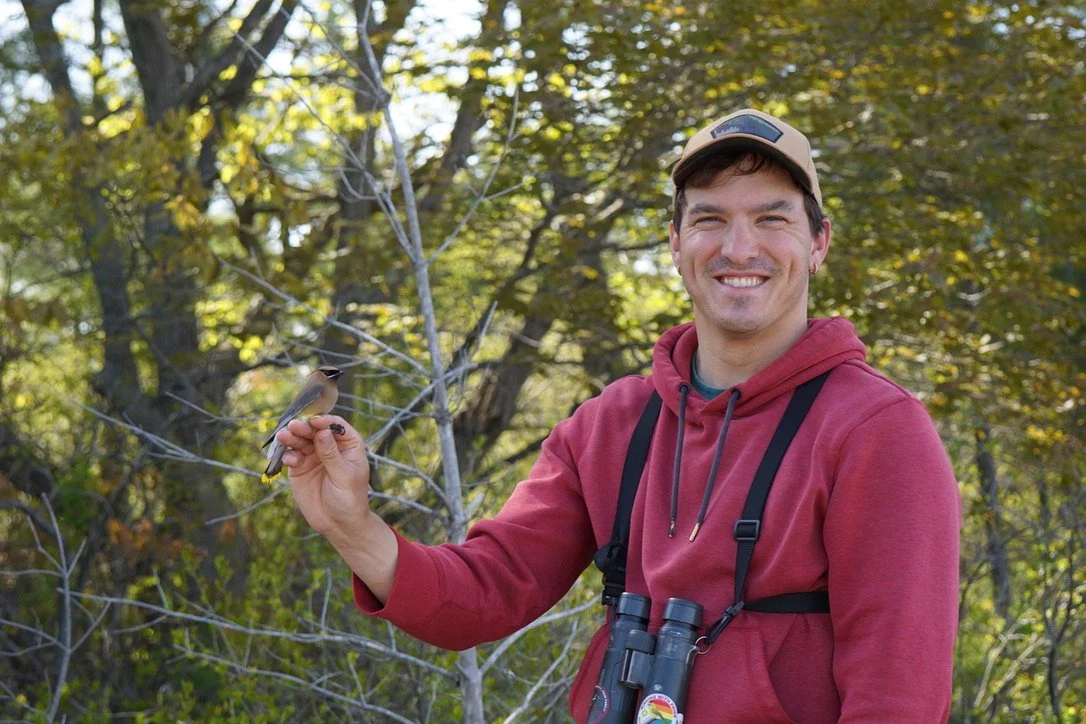
Conservation Director Aaron Rusak with a Cedar Waxwing. Photo by Emily Aitken.
An officially recognized Station Permit for catching and tagging birds is an essential step for effective bird research and conservation. Over the years, Rusak estimates he has handled – and banded – almost 3,000 birds. It’s an experience he’d like everyone to share. While boat access to the area makes visits a challenge, the dream is to establish an accessible banding station where Georgian Bay residents can see the work the Land Trust does and the birds that we study at a close distance, realizing that these small birds might be on their way from South America to an island habitat. Not just any island, mind you, but one that perhaps a personal donation helped to protect.