
A Scissor-Tailed Flycatcher Sighting on Georgian Bay
Last spring, staff members Aaron Rusak and Jenn LeMesurier were lucky to see a very rare scissor-tailed flycatcher while on a site visit to a potential new conservation property in Pointe au Baril. It was a memorable experience. Here’s a conversation between the two of them retelling the story of this very unusual sighting.
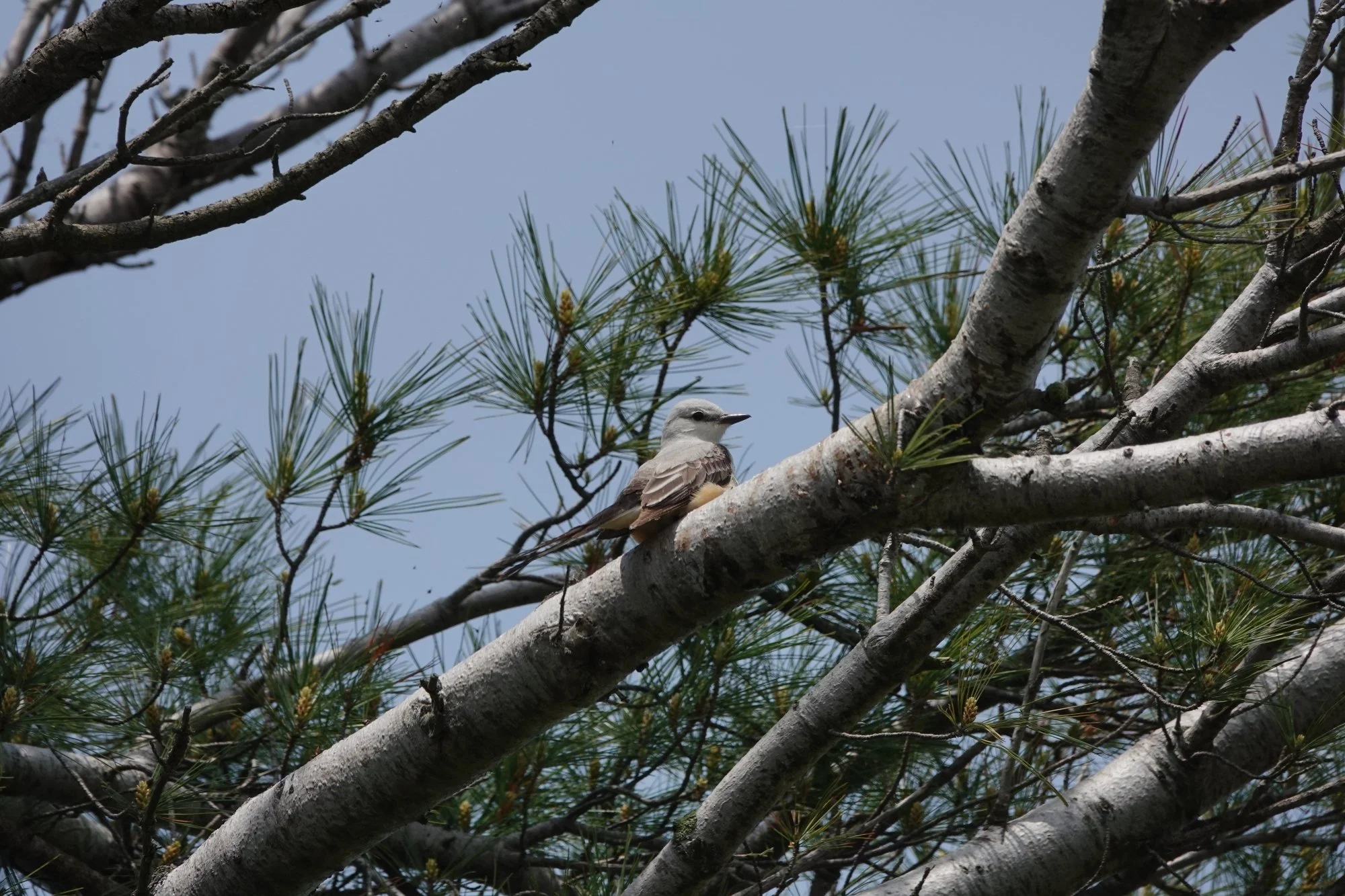
The Scissor-Tailed Flycatcher, photographed by Aaron
Aaron: This was the first time Jenn and I had worked together in a while, so we were talking a lot while we were doing the property inventory. We landed on the north side of the island and then walked around the east side, and I was commenting on how interesting and ecologically significant the island seemed, with all the warblers that were migrating through. Also, one of the first things we heard was a ruffed grouse drumming, which on a five-acre island is pretty weird to start with. Then we rounded a corner, and this bird flew out of the trees and landed in a red cedar. And I knew immediately it was a scissor-tailed flycatcher. And… maybe Jenn can take it better from here, because I completely shut down.
Jenn: I’m actually surprised that you were able to recount up until that point, because I feel like your brain just totally shut off the moment that it all happened. I was trying to frantically take notes on all the vegetation and birds that we were seeing, and you shouted out “that’s a scissor-tailed flycatcher!”. Because I’m not an avid birder, I just figured I would add it to the list, but the next time I looked up you were on your hands and knees on a rock in complete and utter shock. You were gasping and repeating: “I can’t understand what is happening! How are we seeing this bird here?!” You couldn’t stand up, your legs were like jello.
A: Yeah, it’s a blur what happened. The reason I knew it was a scissor-tailed flycatcher immediately is because it has pinky orange armpits under the wing and on a little bit of the breast which I saw as it flew, and then it has these long outer tail feathers which really do look like a pair of scissors. When it catches an insect mid-flight you see it spread its tail and you get this very cool look of its hallmark scissor tail.
J: So then I thought “I gotta see this too”, this is obviously something really cool. And when it flies, the tail feathers really do look like scissors, and it’s quite large and stands out. It was unbelievable to see it there. And then I was trying to get Aaron to tell me why this is so cool, but he’s losing his mind and could barely talk. His legs were shaking, he was on all fours and crawling over to this little ledge to keep looking at it through his binoculars. In between laughter and awe I asked, “do I need to put you in the recovery position? Is this a first aid situation?”
A: We did joke about that because we had just done our first aid training.
J: I couldn’t stop laughing because his reaction was just so over the top, it was really funny. Just sheer joy and bliss. I have never seen someone react like that to seeing something in nature.
A: For reference, this is a bird that breeds in Texas. They’re seen once every couple of years in Ontario, likely when they overshoot their migration, and they’re not seen on Georgian Bay. And so to see one on a remote island was jaw-dropping. And yeah, I totally lost the ability to function for like a solid 45 minutes I would say.
J: It was a long time. I ended up continuing around the island to complete our site visit, so you could catch your breath, take pictures and connect with your birding friends, and just generally pull yourself together. I did another loop and then we met at the boat and you said “I just need to get one more look at it” and went back around.
A: Yeah yeah yeah I went back, a quick look for it.
I think it’s extra special in birding when you recognize a bird immediately. With a lot of birds, you’re looking at field marks and deliberating which species it might be. But with this one, as soon as I saw it fly, I just knew it was a scissor-tailed flycatcher. And I knew it shouldn’t be there. It was the first recorded sighting in the Parry Sound region. Everything came together to make this one of the most impactful birds I’ll probably ever see in my life. And Jenn was just standing there laughing the whole time.
J: The response was over the top, pure joy and exhilaration, and just such a genuine response. I can’t even imagine a child being as purely exhilarated and joyful as you were in that moment. It was really cool, to see somebody that excited about a bird. It gave me a whole other appreciation for birding.
A: And it just goes to show what we’re missing in the natural world within Georgian Bay, because in so many cases a bird like this would have been completely missed. I think there’s a huge wealth of information that we’re not capturing because Georgian Bay is such a massive and complex ecosystem, and there’s so few people out there looking. We need more people birding on Georgian Bay.
