
Rattlesnakes around the Year
Georgian Bay Query: As a cottage owner on Georgian Bay, I'm fascinated by Massasauga rattlesnakes but also a bit wary of them. Should I be concerned about them being on my property? Can you tell me about their behaviour and the types of habitats they prefer throughout the year?
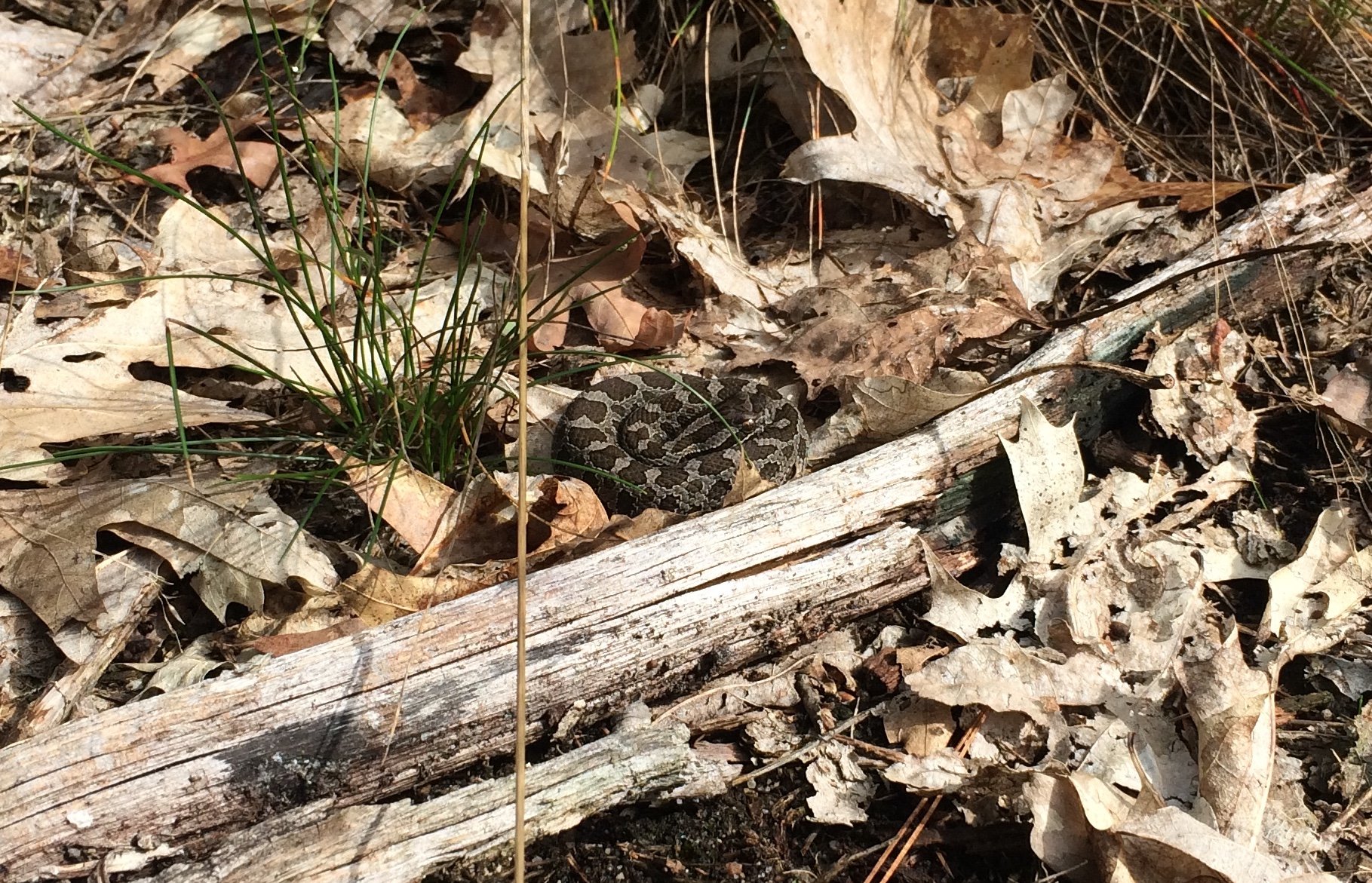
Massasauga rattlesnakes may be one of Georgian Bay’s most misunderstood residents. Despite their fearsome reputation, Massasaugas are truly shy and docile snakes, preferring to avoid conflict. As ambush predators who specialize in hunting small mammals, they have no interest in pursuing humans or our pets. Far from being pests, they actually play a key role in controlling rodent populations.
Rattlesnakes rely on their venom to catch and digest their prey, making it too valuable to waste. Massasaugas have multiple defensive behaviours they will exhaust before resorting to using their venom. When threatened by our presence, their first instinct is to remain still, relying on their bowtie-shaped pattern as camouflage. If discovered, they will flee to nearby cover if possible. If they can’t escape, they will begin to rattle. Rattling is a warning display, a polite request for personal space, rather than a direct threat. Striking behaviour only occurs when they are handled or continuously provoked, lunging forward to ward off what they perceive to be a threat. Striking is often used as a final warning display before resorting to envenomation. Simply put, Massasaugas will do everything they can to avoid using their venom on humans and other non-prey animals.
Not only is it rare for Massasauga rattlesnakes to bite humans, but they also have one of the least potent venoms of all rattlesnakes. Massasauga rattlesnakes have resulted in only 2 human deaths in Ontario throughout recorded history, with both occurring over 50 years ago. Nevertheless, if you suspect that you have been bitten by a Massasauga, you should remain calm and visit the nearest hospital as soon as possible. While their bites are rarely fatal and do not always carry venom, untreated bites can result in severe health complications.
If you do happen to come across a Massasauga on your property, you will want to remember that they can only strike within a distance that is equal to under half of their total body length. Massasaugas are a relatively small rattlesnake: adults are typically between 55 and 80 centimetres long. You can therefore ensure your safety by always remaining at least 2 meters away from them.
While finding a Massasauga rattlesnake on your property is rare, it is not a great reason for concern. Massasaugas have specialized habitat requirements and do not spend long periods of time in areas that are close to human activity or developments. In fact, habitat loss due to human development is one of the greatest factors resulting in the species’ rapid population decline over the last few decades. Learning to coexist in Georgian Bay with Massasauga rattlesnakes is not only necessary for their survival, but also part of the Georgian Bay’s natural heritage.
Furthermore, as a species-at-risk, Massasauga rattlesnakes and their habitats are both federally and provincially protected. It is illegal to kill, harm, or harass Massasaugas, and it is similarly illegal to damage or destroy their critical habitats. Having knowledge of the types of habitats Massasaugas rattlesnakes prefer can help us to respect their boundaries and avoid interactions. Similarly, it is important to understand why Massasaugas can be found in different habitats at different times of the year, as their movement patterns are closely tied to their life cycle and survival requirements. It is therefore best to describe their habitat use by each season.
Spring: Awake After Winter
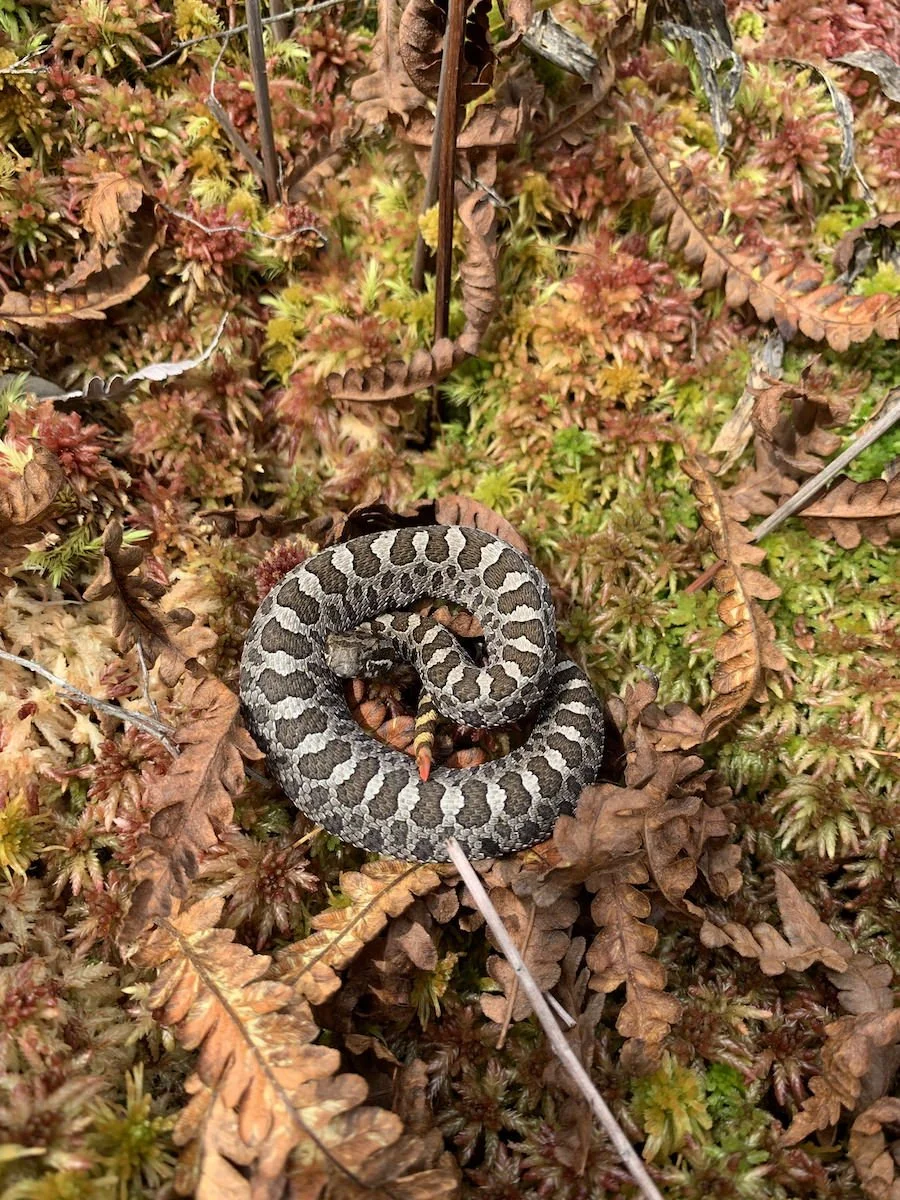
Massasauga rattlesnake basking in a hibernation fen
As the sun shines and the frost melts in mid to late spring, Massasaugas emerge from their six-month winter rest. Their top priority is to regain their strength by basking in the sun and foraging for food. They can be found around their hibernation wetland habitats - peatlands, such as treed fens and thicket swamps, that are rich in moss. Spring is also mating season, where males may travel up to a kilometre in search of a partner. As temperatures rise, rattlesnakes gradually begin moving between wetland and drier upland habitats.
Summer: Months of Massasauga Mothers

A pregnant Massasauga rattlesnake at her chosen gestation rock
People most often encounter rattlesnakes in the summer due to the behaviour of pregnant Massasauga females. Despite the common belief that all snakes lay eggs, Massasaugas give live birth. As cold-blooded reptiles, Massasaugas cannot produce internal heat and instead must regulate their body temperature through external sources. To support embryo development, pregnant females will search for an appropriate rock barren habitat to serve as a gestation site over the summer months.
The perfect gestation rock must have access to open sun for warmth, space beneath for refuge and cooling shade, and nearby low shrubs like junipers and blackberry bushes for protection. Massasauga mothers will remain at their chosen site for most of the summer. Although this might seem like trivial information, avoiding these habitat features during the summer can help reduce rattlesnake encounters. Males and non-reproductive females move more freely between habitats and along forest edges in search of rodents, but typically stay within one kilometre of their hibernation wetlands during the active season.
Fall: Baby Snakes on the Move
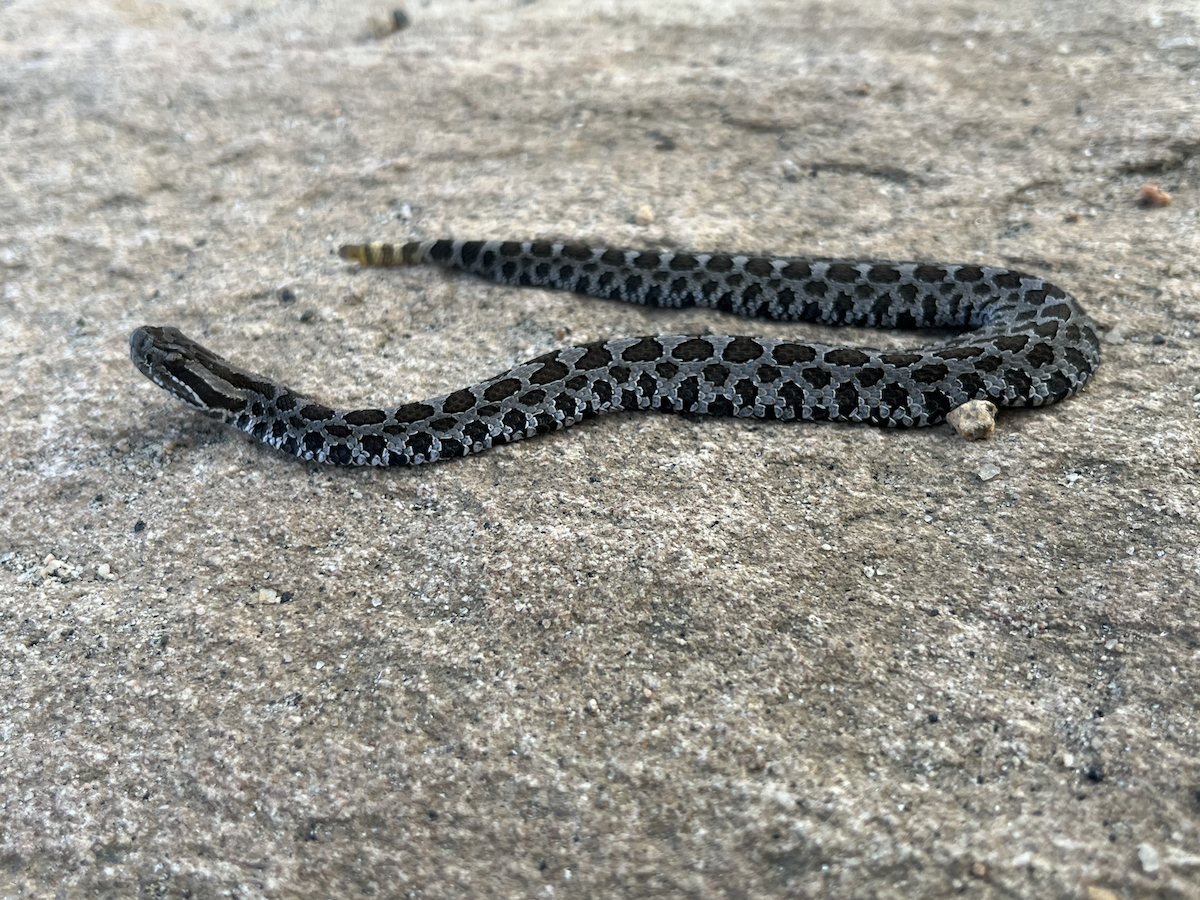
A juvenile Massasauga rattlesnake during fall migration
As leaves change and temperatures cool, Massasaugas start crossing upland habitats to return to the same wetlands they left in the spring. This is also the season of baby snakes! While newborn rattlesnakes still carry venom, they cannot rattle, as they are only born with one rattle segment. They are only 15 to 25 centimetres long and easy to avoid as long as you are wearing closed-toe shoes.
Autumn is a dangerous time of year for Massasauga rattlesnakes due to roads fragmenting their habitat, cutting through vital movement corridors. With small home ranges and highly specific habitat needs, Massasaugas often have no choice but to cross roads to return to their hibernation site. Their slow movement and the heat-retaining asphalt of roads (where snakes tend to linger for warmth) make Massasaugas vulnerable to vehicles. Reptile road mortality spikes during rattlesnake migratory periods in both the spring and fall. Georgian Bay residents can help protect wildlife by being aware and stopping their vehicles for the safe passage of animals.
Winter: Below the Frost
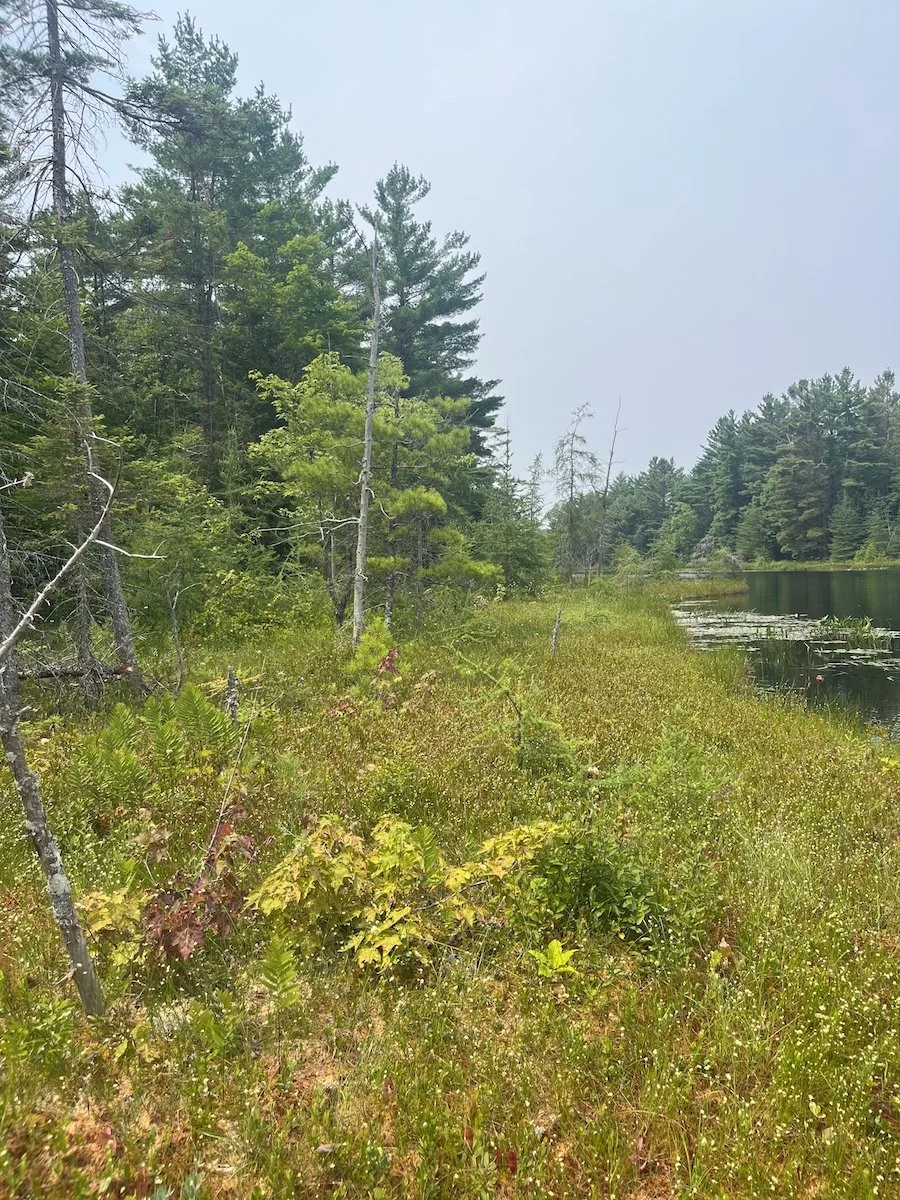
This mossy fen provides Massasauga overwintering habitat
As temperatures drop and winter returns, Massasaugas must find refuge from the upcoming frost. Peatlands with mossy hummocks – moss mounds over root channels with hollow spaces – provide an ideal overwintering habitat for rattlesnakes. Hummocks deeper than the frost layer protect the snakes from the Georgian Bay cold. These microhabitat features are vital for winter thermoregulation and the survival of Massasauga rattlesnakes, yet these fragile hibernation sites are in decline across Ontario. Agricultural land use and ground water depletion have led to the loss of many key hibernation wetlands for Massasaugas.
While habitat loss and the impacts of roads have led to the near collapse of Massasauga rattlesnake populations in Southern Ontario, the eastern shore of Georgian Bay still holds the largest remaining population across their entire species range. While limited development in eastern Georgian Bay has helped preserve hibernation wetlands and gestation sites, plans of expanding development threaten the future of these critical habitats.
At the Georgian Bay Land Trust we are taking on the fight to protect our wildlife and their habitats. Our Corridor Project plans to establish a permanent migratory haven for species-at-risk by connecting a 62,900-acre protected habitat corridor along the eastern shore - learn more here.
